

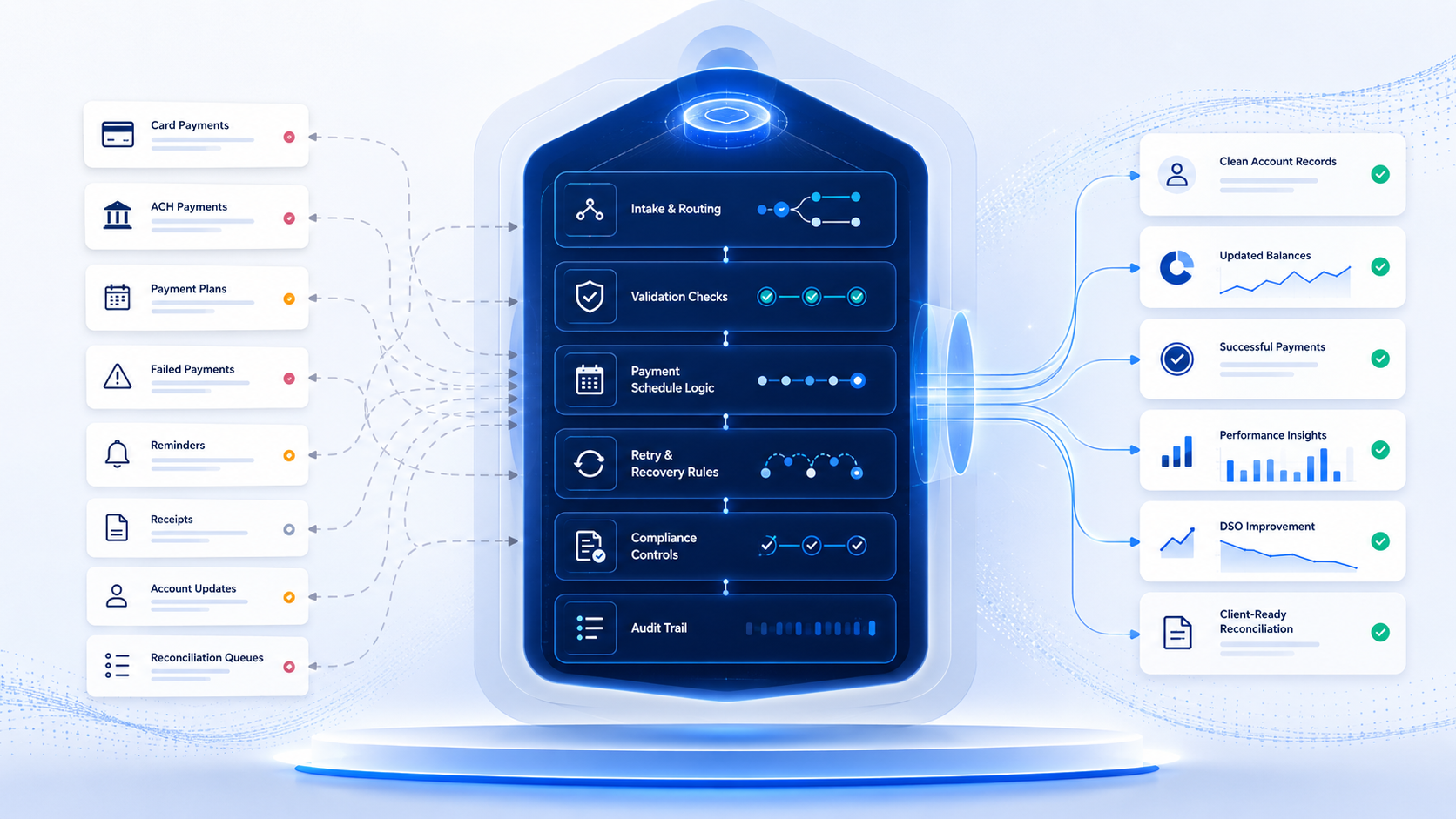
Debt collection payment automation helps agencies turn a consumer’s intent to pay into posted, reportable revenue with less operational drag. It connects payment plans, digital payments, payment processing, reminders, failed-payment handling, account updates, client reporting, and reconciliation inside the agency’s core workflow.
That matters because the payment moment is where many agencies lose speed. A consumer agrees to resolve an account, but the team still has to document authorization, send the right link, schedule follow-up, update balances, stop the wrong outreach, post funds, and report activity back to clients. When those steps rely on manual processes, every resolved account creates avoidable work.
For enterprise agencies, payment automation is not just a convenience feature. It is part of the debt collection process because payments, communication, compliance, and account status all have to move together.
Why Payment Automation Matters in the Debt Collection Process
Collection agencies are under pressure to recover more while keeping teams lean, clients informed, and consumer communication controlled. A weak payment workflow slows all of that down. Collectors spend time chasing reminders, finance teams reconcile exceptions, and managers struggle to explain performance when payment data is delayed or fragmented.
A stronger workflow helps agencies improve recovery rates by making it easier for consumers to act when they are ready. It also gives managers cleaner visibility into what happened after a promise to pay: who paid, who missed, who needs a reminder, and which account requires human review.
Payment automation should support the full debt recovery process, not just the transaction. That means the system should manage the steps before, during, and after payment: offer setup, authorization, receipts, account updates, collector visibility, client reporting, and exception routing.
Payment Plans, Digital Payments, and Payment Processing
The first requirement is simple: make it easy for consumers to pay without creating extra work for the agency. Modern debt collection software should support card, ACH, portal, text-to-pay, recurring schedules, and settlement workflows where appropriate.
Payment plans should be easy to configure based on balance, client rules, settlement authority, and consumer preference. Once an arrangement is accepted, the system should document authorization, schedule future activity, update the account, and make the plan visible to collectors and supervisors.
Digital payments are especially important because consumers often prefer to resolve accounts without waiting on a live agent. Self-service options let consumers review balances, choose available terms, update payment methods, and complete payment from a secure portal or link. That reduces friction for consumers and reduces manual follow-ups for staff.
Payment processing also needs to stay connected to the account record. If a transaction succeeds, fails, reverses, or settles, the account should reflect that quickly so outreach, queues, reports, and client files do not drift out of sync.
Automated Payment Reminders and Failed-Payment Handling
Automated payment reminders are one of the highest-value uses of payment workflow automation. The goal is not to blast every consumer with the same message. The goal is to send the right reminder at the right time, through an allowed channel, based on the account’s status, consent, communication history, and arrangement terms.
Automated follow-ups are just as important after a missed or failed payment. A card decline may call for a secure payment-method update link. An ACH return may require a collector task. A repeated failure may require a manager's review or a different treatment path.
This is where automated collection systems outperform disconnected tools. Instead of asking staff to identify every exception by hand, the system can route failed payments into escalation workflows with the right next step. That keeps delinquent accounts from sitting in limbo and helps debt collectors focus on conversations that require judgment.
Payment Plan Timing Tips for Fewer Failed Payments
Payment plans work best when the schedule matches the consumer’s actual cash flow. Instead of setting every arrangement on a generic monthly date, collectors should ask when the consumer typically gets paid and align scheduled payments as close to that payday as possible.
Timing matters because consumers may have multiple automated transactions competing for the same funds. A rent payment, utility bill, subscription, loan payment, or card auto-pay can hit the same account around the same time. If the collection payment runs too late in the day or several days after payday, the funds may already be gone.
One practical approach is to schedule recurring payments early in the morning, such as 5 or 6 AM local time, when permitted by the agency’s processor and internal policy. That gives the payment a better chance of being one of the first transactions to hit the card or bank account that day.
Agencies should also build workflows that make payment-plan timing easy to manage. The system should capture payday details, schedule reminders before the payment date, retry failed payments according to approved rules, and route repeated failures to a collector or manager for review. This turns payment plans from a static promise into a managed workflow that can reduce avoidable bounces and improve recovery consistency.
AI, Predictive Analytics, and Debt Recovery Automation
AI can improve payment workflows when it helps teams make better decisions about timing, routing, and prioritization. Predictive analytics can identify which accounts are likely to respond to a reminder, which payment methods are most likely to succeed, and which exceptions need faster collector attention.
Machine learning can support segmentation by balance, payment history, engagement channel, failure reason, and consumer behavior. Real-time analytics can turn daily activity into data-driven insights, such as promise-to-pay conversion, failed-payment reasons, portal adoption, reminder performance, and payment method trends.
The practical value is not “AI for AI’s sake.” The value is debt recovery automation that helps agencies decide what should happen next. Automated outreach can handle routine payment nudges, while sensitive accounts or repeated exceptions can be routed to a human collector. Done well, this improves productivity without removing human oversight.
Compliance, Audit Trails, and Payment Controls
Payment workflows do not operate separately from compliance. Agencies still need to account for the FDCPA, Regulation F, state rules, client requirements, consent status, and internal policy. For card transactions, teams should also understand the role of PCI standards in protecting payment data.
Compliance management should be built into the workflow instead of being handled after the fact. That includes role-based permissions, approved templates, contact-frequency controls, time-zone logic, and clear review paths for exceptions.
Audit trails matter because payment activity often needs to be explained later. The agency should be able to show when an arrangement was created, who authorized it, which reminders were sent, what payment event occurred, how the account changed, and which user or workflow took the next action.
What to Look for in Debt Collection Software
A payment page alone is not enough for enterprise operations. Debt collection software should connect payments to the operating model of the agency.
Look for capabilities such as:
Integrated or bring-your-own payment processor flexibility
- Card, ACH, recurring, settlement, and arrangement support
- Consumer portal and text-to-pay workflows
- Rules for client-specific payment terms and settlement authority
- Automated payment reminders tied to account status
- Failed-payment routing and exception queues
- Real-time dashboards for payments, exceptions, and collector performance
- Reporting and analytics for managers, clients, and finance teams
- API connections with payment providers, portals, dialers, client systems, and ERP systems
- Role-based access, approval controls, and compliance review paths
- The strongest platforms do not force every creditor client or portfolio into the same payment process. They let operations leaders configure workflows by balance, account type, client, channel, jurisdiction, and risk level.
How Aktos Supports Payment Workflow Automation
Aktos gives agencies modern debt collection software for connecting payment workflows with account data, communication, reporting, and automation. Agencies can support consumer self-service, integrated payment workflows, no-code automation, client visibility, and open API connections without relying on disconnected systems.
This matters because payment work touches almost every team. Collectors need current account context. Managers need exception visibility. Finance teams need cleaner reconciliation. Clients need trustworthy reporting. Consumers need a straightforward way to resolve accounts.
Aktos helps agencies design workflows that match how they operate, including reminders, arrangements, payment posting, failed-payment routing, client-specific reporting, and controlled escalations. For more context, see Aktos guides on what to look for in debt collection software, API integration for enterprise agencies, and AI in debt collection.
Best Practices Before Automating Payments
Before automating payments, agencies should document the workflow they actually want to enforce. Start with the operational rules:
Which payment methods are available by client and portfolio?
- Who can approve settlements or arrangement changes?
- What happens after the first, second, or repeated payment failure?
- When should outreach pause after a successful payment?
- Which messages require compliance review?
- How quickly should the client see payment activity?
- Which exceptions require human review?
- The best automation does not simply speed up a broken process. It removes unnecessary steps, reduces manual data entry, improves visibility, and keeps human judgment where it belongs.
Final Thoughts: Payment Automation Is Revenue Infrastructure
Payment automation is revenue infrastructure for modern collection agencies. It helps teams move faster from promise to payment, from payment to account update, and from account update to client reporting.
When workflows are connected, consumers get clearer options, collectors spend less time on administrative work, and managers get a cleaner view of performance. When workflows are disconnected, even good collection activity can turn into delays, exceptions, and reporting gaps.
For agencies that want to improve payment operations, the path forward is not another isolated portal or processor login. It is a connected platform that supports payment workflow, compliance, reporting, and debt recovery from the same operational foundation.


