
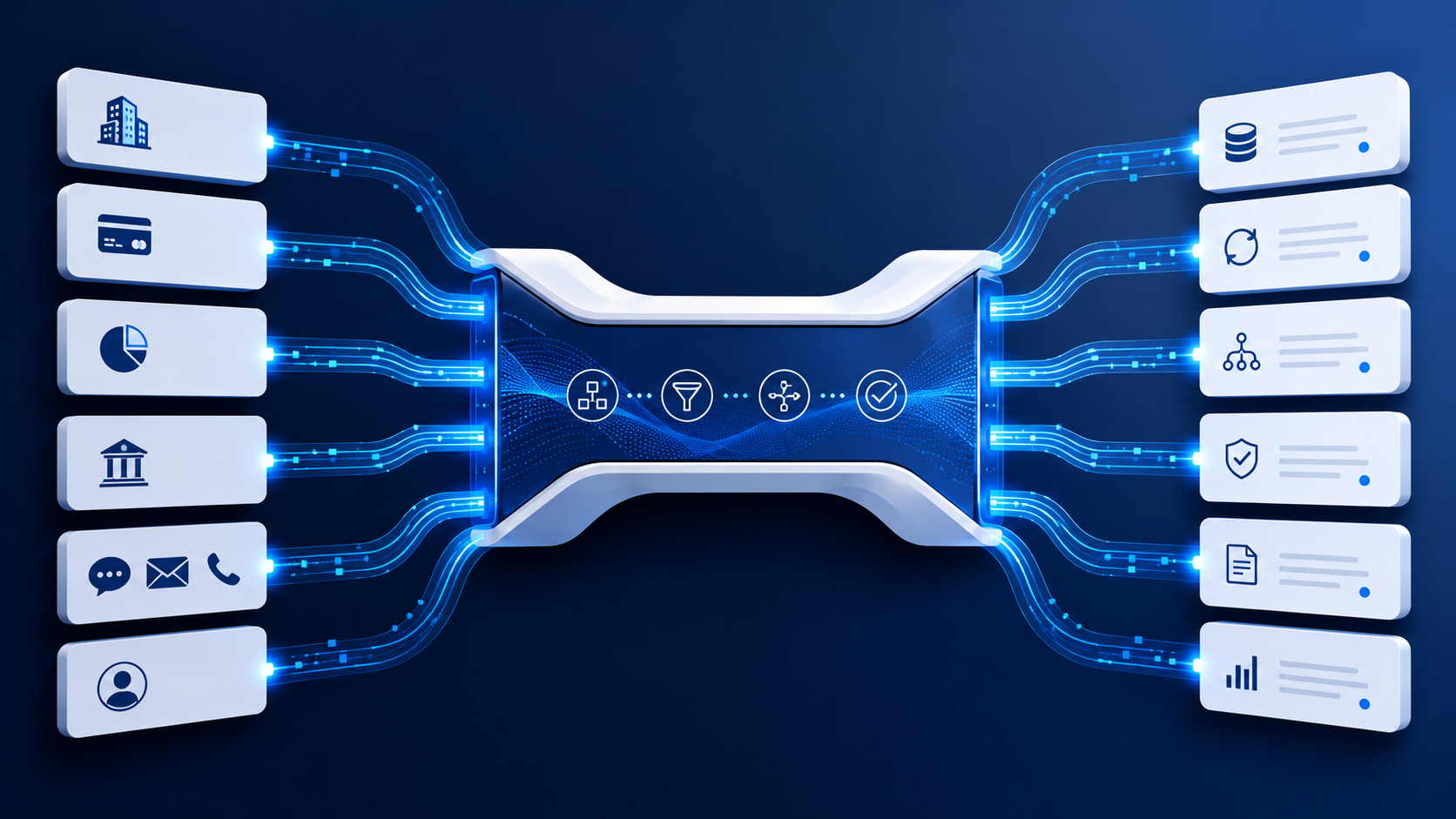
Collection agencies do not work inside one clean system. Every account starts somewhere else: a creditor CRM, bank core, ERP, hospital billing system, loan servicing platform, credit union database, or proprietary client workflow.
That means debt collection software must do more than store accounts after placement. It must connect creditor systems, payment processors, payment gateways, credit bureaus, accounting systems, communication channels, dispute management workflows, and client reporting loops without manual data entry.
For growing and enterprise debt collection agencies, integrations determine how fast accounts move, how quickly online payments post, how safely consumer debt workflows run, and how much confidence clients have in reporting.
Why Integrations Matter In Debt Collection Software
When integrations are weak, the agency feels it everywhere.
A consumer pays through a self-service portal, but the collector still sees an outdated balance. A creditor sends a recall, but the account stays active in the agency CRM. A dispute arrives through email, but the dialer keeps calling. A client asks for real-time reporting, but operations rebuilds the story from exports.
These delays create consumer friction, compliance risk, client frustration, avoidable bad debt follow-up, and back-office cleanup.
Strong debt collection software integrations create the opposite operating rhythm. Account records stay current. Payments update quickly. Workflows trigger automatically. Collectors trust the account screen. Clients see real-time dashboards instead of stale monthly files.
The Core Systems Collection Agencies Need To Connect
Every agency stack is different, but most integration needs fall into a few practical categories.
Creditor CRMs, ERPs, And Placement Feeds
The most important integration is the creditor-to-agency data flow. Agencies need placements, updates, recalls, balance changes, documents, consumer details, credit score fields when authorized, and client-specific portfolio rules.
For high-volume clients, APIs usually support cleaner exchange than manual imports. A strong API can validate fields, map creditor data, identify exceptions, and route accounts before collectors touch them.
Payment Processing And Payment Gateways
Payment data must sync fast. If a consumer pays through a portal, text-to-pay link, ACH flow, card transaction, AI phone agent, or live collector, the account should update promptly.
A payment gateway layer should not operate separately from the collection platform. Payment processing should update balances, stop unnecessary payment reminders, refresh client reporting, and support finance reconciliation. Agencies also need flexibility to switch processors without rebuilding the entire workflow.
This is especially important when balances include fees, interest rates, or multiple portfolio rules. Agencies need a controlled way to sync those fields and avoid inconsistent account conversations.
Accounting Systems And Financial Reconciliation
Collection operations and accounting do not need to live in the same system, but they do need to stay aligned. Agencies may use a separate accounting system for invoicing, remittances, commissions, and reconciliation. The key is making sure payment activity, account status, fee logic, and remittance data flow cleanly between systems so operations and finance are working from the same source of truth.
The collection platform should remain the operational single source of truth for account activity, while accounting systems receive the clean financial events they need. That gives executives a clearer view of cash flow, DSO, client profitability, and accounts receivable management.
Credit Bureaus, Communication Channels, And Portals
Some agencies support credit bureau workflows, credit reporting updates, or credit scoring inputs. Those workflows require careful controls because disputes, payment status, suppression rules, and documentation can affect what happens next.
Calls, SMS, email, voicemail, letters, portals, and AI-assisted conversations should also feed the same record. If SMS receives an opt-out, that event should update the account. If a consumer makes an online payment through a self-service portal, outreach should adjust.
Self-service portals are not just convenience features. A self-service portal can reduce inbound volume, support online payments, collect documents, capture disputes, and update workflows without rekeying.
What API-Based Integration Should Actually Do
An API is valuable only when it supports real work. Saying “we have APIs” is not enough. The better question is whether the API can read and write needed data, trigger automated workflows, and create an audit trail. For a deeper breakdown of how APIs support placements, payments, disputes, reporting, and workflow triggers, see Aktos’ guide to debt collection API integration for enterprise agencies.
For example, an API-driven placement process can receive the account, validate data, assign the portfolio, apply rules, check consent, trigger an automated workflow, route exceptions, and update real-time dashboards. If the consumer later pays, the API can update the balance, pause follow-up, refresh reporting, and notify the creditor.
That is the difference between data transfer and workflow orchestration. The API is not just plumbing. It is part of the decision engine that helps the agency act on current information. Machine learning models for prioritization or risk scoring only work well when they are fed accurate, current, permissioned data.
Pre-Built Connectors Versus Custom Integration Projects
Pre-built connectors can speed implementation when they are designed around real collection workflows. But a connector that only pushes one-way data once per day can still create stale balances and reporting gaps. A custom API integration can be stronger if it supports bidirectional sync, error handling, field mapping, event triggers, and client-specific governance. This is also why agencies should understand why collection software integrations fail before choosing a platform or approving a new connector.
The Cost Of Closed Ecosystems
Closed ecosystems create a quiet growth ceiling. If debt collection software only supports one payment processor, one dialer, one SMS provider, or one portal, the agency loses leverage.
That lock-in can raise costs, slow onboarding, limit innovation, and force teams to accept weaker functionality.
For agencies handling multiple clients, portfolios, and debt types, flexibility matters. A modern platform should support configurable workflows, open API architecture, intelligent workflows, and the ability to automate workflows without a development ticket.
Integration Governance, Security, And Compliance
Integrations move sensitive data. Agencies need to know who can read data, who can write data, which system owns each field, how credentials are managed, and whether every change is logged.
For API security, the OWASP API Security Top 10 is a useful reference for broken authorization, broken authentication, unrestricted resource consumption, and unsafe API consumption. For payment workflows, PCI Security Standards Council guidance is also relevant for protecting payment data.
Debt collection also has communication and validation requirements. The Fair Debt Collection Practices Act and the CFPB’s Regulation F are key federal references, and agencies should coordinate with counsel on FDCPA, Reg F, and state-specific obligations.
Operationally, compliance depends on sync quality. If one system records a dispute but another system keeps sending automated follow-ups, the integration failed the workflow. If a consumer revokes consent in one channel and another channel continues outreach, the integration has failed the process.
How Integrations Improve Collector Productivity
When systems are disconnected, collectors jump between screens to confirm balances, review documents, check payment status, find call outcomes, review dispute notes, or understand next steps. That slows conversations and increases errors.
When systems are connected, collectors work from a fuller account view: payment history, balance, outreach, dispute status, documents, consent signals, and workflow instructions. That makes it easier to automate follow-ups, avoid duplicate outreach, and resolve accounts with fewer handoffs. The same applies to case management: next actions should update from real events, not manual rework.
How Aktos Supports Integration-Driven Collections
Aktos is modern debt collection software for agencies that need connected workflows, not disconnected tools. Agencies can connect creditor systems, payment processing providers, dialers, SMS and email tools, credit bureaus, accounting systems, reporting tools, client portals, and self-service portals through APIs and native integrations.
The value is connectivity tied to work: placement intake, validation, routing, automated follow-ups, payment posting, dispute management, client reporting, audit trails, real-time dashboards, and decision engines that guide next actions.
Integration problems rarely stay in IT. Aktos helps agencies turn integrations into a working operating layer instead of fragile handoffs.
Questions To Ask Before Choosing A Platform
For a broader evaluation framework, Aktos’ guide to the best collection agency software for growing teams covers the platform capabilities agencies should compare beyond integrations alone.
Before choosing debt collection software, ask:
- Can the platform support both pre-built connectors and custom APIs?
- Which systems can read and write account data?
- Can payment events update balances, workflows, and reporting in real time?
- Can the system automate workflows without custom code?
- Can permissions limit access by client, user, field, or workflow?
- Does the vendor understand collection agency operations?
Final Thoughts
Debt collection software integrations are no longer a back-office detail. They shape how collection agencies scale, serve enterprise clients, reduce errors, protect consumer experience, and build trust.
Weak integrations create stale data, duplicate outreach, payment confusion, reporting delays, and manual work. Strong integrations create cleaner records, faster workflows, stronger controls, and fewer handoffs.
If your agency relies on brittle connections, closed ecosystems, or manual reconciliation, it is an operating model problem.
Want to see how Aktos connects creditor systems, payments, workflows, and reporting? Book a demo.