

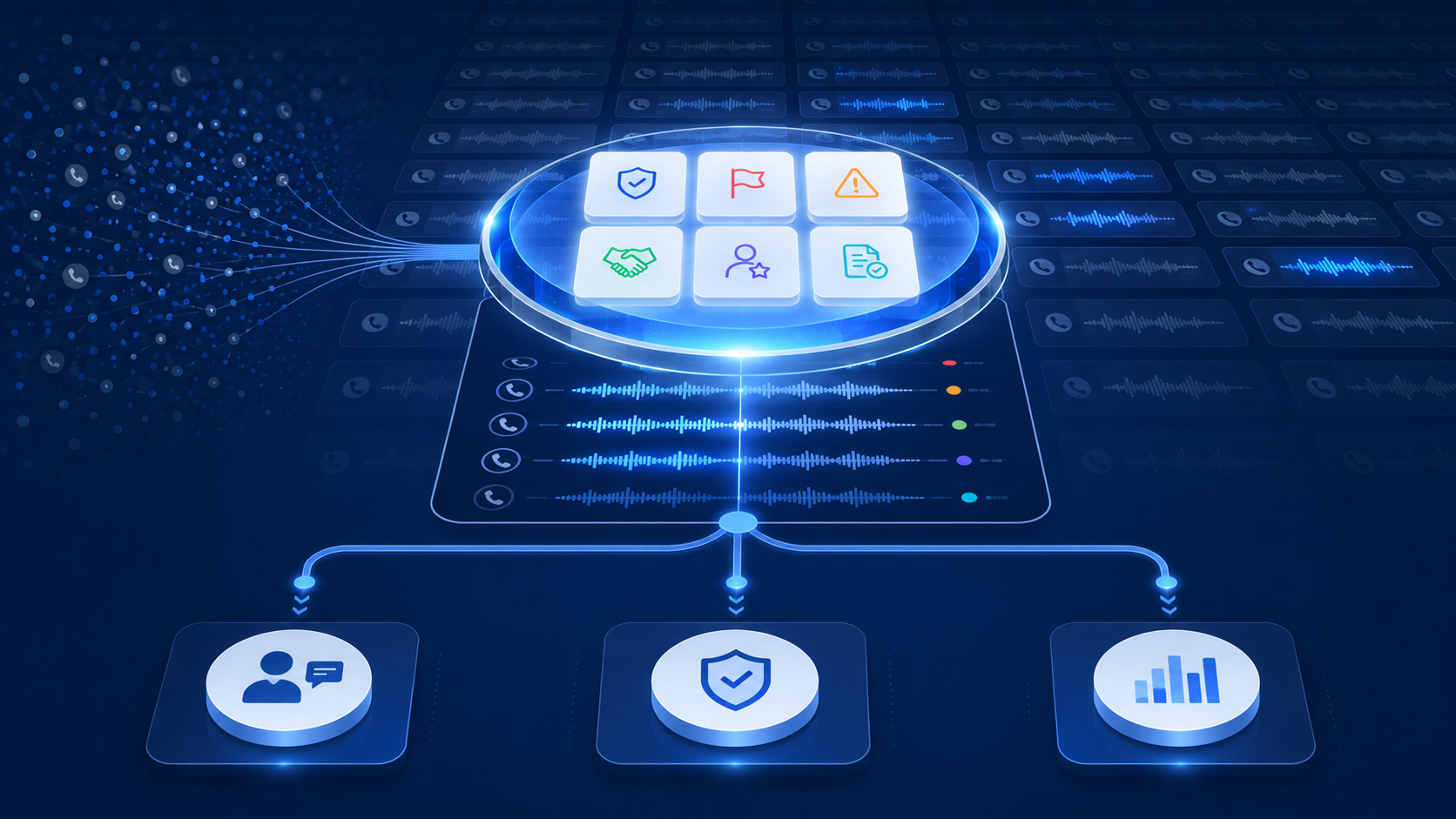
Debt collection QA used to mean pulling a few calls, filling out scorecards, and hoping the sample reflected what was happening across the floor. That approach breaks down when an agency manages high-volume placements from lenders, AI phone agents, complex workflows, and stricter client oversight.
Today, QA is part of the agency’s compliance management system. It helps leaders confirm whether each debt collector is following approved scripts, delivering disclosures, documenting payment conversations, identifying disputes, and escalating sensitive accounts before they become complaints.
The calls multiplied, but the QA team did not. Agencies need a faster way to find risk, coach collectors, and prove control across the debt collection process.
Why Traditional QA Misses Too Much
Most collection agencies already review calls. A supervisor may review a few calls per collector each month. Compliance may investigate after a complaint. Client services may search for examples before a business review. The highest-risk calls are not always the calls selected.
Manual sampling also creates lag. By the time a pattern is found, it may have repeated across hundreds of accounts. A collector might perform well on sampled calls and still miss a disclosure during a dispute, settlement, wrong-party call, or repossession-related conversation.
Strong QA still needs human judgment. It just should not rely on random sampling alone. Agencies need automation that can review transcripts, flag exceptions, and route the right conversations to reviewers.
The Compliance Foundation
A QA program should reflect the laws, client requirements, and internal controls that shape collection activity. At the federal level, agencies commonly monitor alignment with the Fair Debt Collection Practices Act, Regulation F, and the Telephone Consumer Protection Act. The Consumer Financial Protection Bureau also maintains CFPB resources covering communication, disputes, validation, and record retention.
Operationally, QA should make regulatory compliance measurable. A policy in a binder is not enough. Supervisors need evidence that the Fair Debt Collection Practices Act (FDCPA), TCPA, CFPB guidance, state rules, client instructions, and compliance risks are being tracked across calls, SMS, email, voicemail, letters, and portal activity.
What AI-Assisted QA Actually Does
AI-assisted QA does not replace supervisors or legal review. It gives them a stronger first pass.
Instead of relying only on random samples, AI can review transcripts, summarize conversations, identify risk phrases, and surface calls that need attention. In a modern collection platform, automation can support call summaries, transcript search, disclosure checks, QA rubrics, risk alerts, coaching queues, and audit evidence for client reviews or regulator response preparation.
For agencies still defining where AI fits into daily operations, this broader guide to AI in debt collection explains how leading teams are using automation, AI phone agents, and real-time workflows across the collection lifecycle.
That turns QA from a retrospective checklist into a live operating layer.
The QA Categories Agencies Should Track
Disclosure and identification quality
Debt collection calls often require specific disclosures depending on account type, channel, and stage of communication. Agencies should review whether the collector or AI agent identified the agency, verified the consumer appropriately, and delivered required language when needed.
Dispute, verification, and complaint handling
Disputes change what should happen next. When a consumer disputes the balance, asks for verification, says the wrong person is being contacted, or claims identity theft, the conversation should trigger the correct workflow. AI can flag likely dispute language; human reviewers can confirm the classification.
Payment conversation accuracy
Payment conversations must be clear and documented. QA should review whether collectors explained options accurately, captured promises correctly, confirmed dates and amounts, and avoided unsupported statements.
This includes payment plans and complex conversations involving principal, minimum payments, settlements, fees, and interest rate questions. If a consumer asks whether an interest rate applies to a car loan or whether principal includes interest, the collector should follow approved guidance. If a consumer asks about debt consolidation, debt management, credit management, debt consolidation options, or credit rating, QA should confirm the collector does not drift into financial advice.
Broad consumer questions that can derail calls
Consumers may bring up broader financial concerns during a call, including inflation, interest rates, treasury bonds, or even the national debt. QA should confirm that collectors do not turn those topics into financial advice or use them to pressure payment. The collector’s role is to stay anchored to the specific account: the balance, creditor documentation, payment options, dispute rights, and approved next steps. If a consumer asks whether an interest rate, national debt headline, or larger economic issue affected their account, the collector should avoid speculation and redirect the conversation back to the account record.
Escalation quality and tone
Not every call should stay with the first debt collector or AI agent. Some conversations require a supervisor, compliance officer, client-specific queue, or human follow-up. QA should measure missed and unnecessary escalations. It should also evaluate whether the conversation was professional, clear, and resolution-oriented.
How QA Improves Debt Recovery
Better QA can improve debt recovery by making conversations cleaner, faster, and more consistent. When collectors explain options clearly, document promises accurately, and escalate disputes correctly, fewer accounts stall.
For example, QA may show that consumers with car loan accounts are confused when collectors explain fees and interest rate details. It may show that settlement conversations lose momentum because collectors do not confirm minimum payments. Each finding can become a workflow update, coaching module, or script improvement that supports recovery rates without adding more manual review.
What Changes With AI Phone Agents
AI phone agents introduce a new QA layer. Agencies are no longer only reviewing human collectors. They are reviewing automated conversations, routing logic, disclosure behavior, escalation quality, and account-data accuracy.
The question is not whether the AI sounded good. The question is whether it operated inside the agency’s rules. Agencies should review whether the AI agent verified identity, delivered disclosures, recognized dispute or hardship language, escalated complex conversations, logged notes, updated account records, and respected consent status. For more on AI guardrails, see Aktos’ guide to AI phone agent compliance.
How Aktos Supports Modern QA
Aktos helps agencies make QA part of the operating system instead of a separate manual process. Call activity, account context, payment outcomes, workflow status, audit trails, AI phone agents, and reporting can live in one connected platform.
Agencies evaluating whether their current platform can support modern QA should know what to look for in debt collection software, including audit trails, workflow automation, reporting, integrations, and compliance controls.
That gives supervisors better coaching data, compliance teams stronger documentation, and client services teams clearer reporting. Agencies still need counsel for legal interpretation, but the right software makes approved rules easier to operationalize inside a compliance management system.
Final Thoughts
Debt collection Quality Assurance is moving from random sampling to intelligent review. Manual QA alone cannot keep up with human calls, AI-assisted calls, SMS, email, letters, and portal interactions. AI-assisted QA helps agencies review more conversations, find risk faster, coach collectors better, and give clients the transparency they expect.
FAQs
Q: What is debt collection QA?
A: Debt collection QA is the process of reviewing collection interactions to confirm that collectors follow approved scripts, document conversations correctly, handle disputes properly, and stay aligned with agency policies and compliance requirements.
Q: Can AI replace human QA reviewers?
A: No. AI can review transcripts, flag risks, summarize calls, and route issues, but human reviewers should make final judgments on coaching, compliance escalation, and policy interpretation.
Q: What should QA teams review on collection calls?
A: QA teams should review identification, disclosures, tone, payment conversations, dispute handling, escalation decisions, documentation accuracy, and whether the account moved into the right next workflow.
Q: How does QA support regulatory compliance?
A: QA helps agencies turn rules into measurable controls, highlight exceptions, and maintain evidence when clients or regulators ask what happened.


