A collection agency can have strong software across its stack and still struggle if placements, payments, communications, and reporting do not move together. The problem is not simply moving data; it is coordinating what happens next.
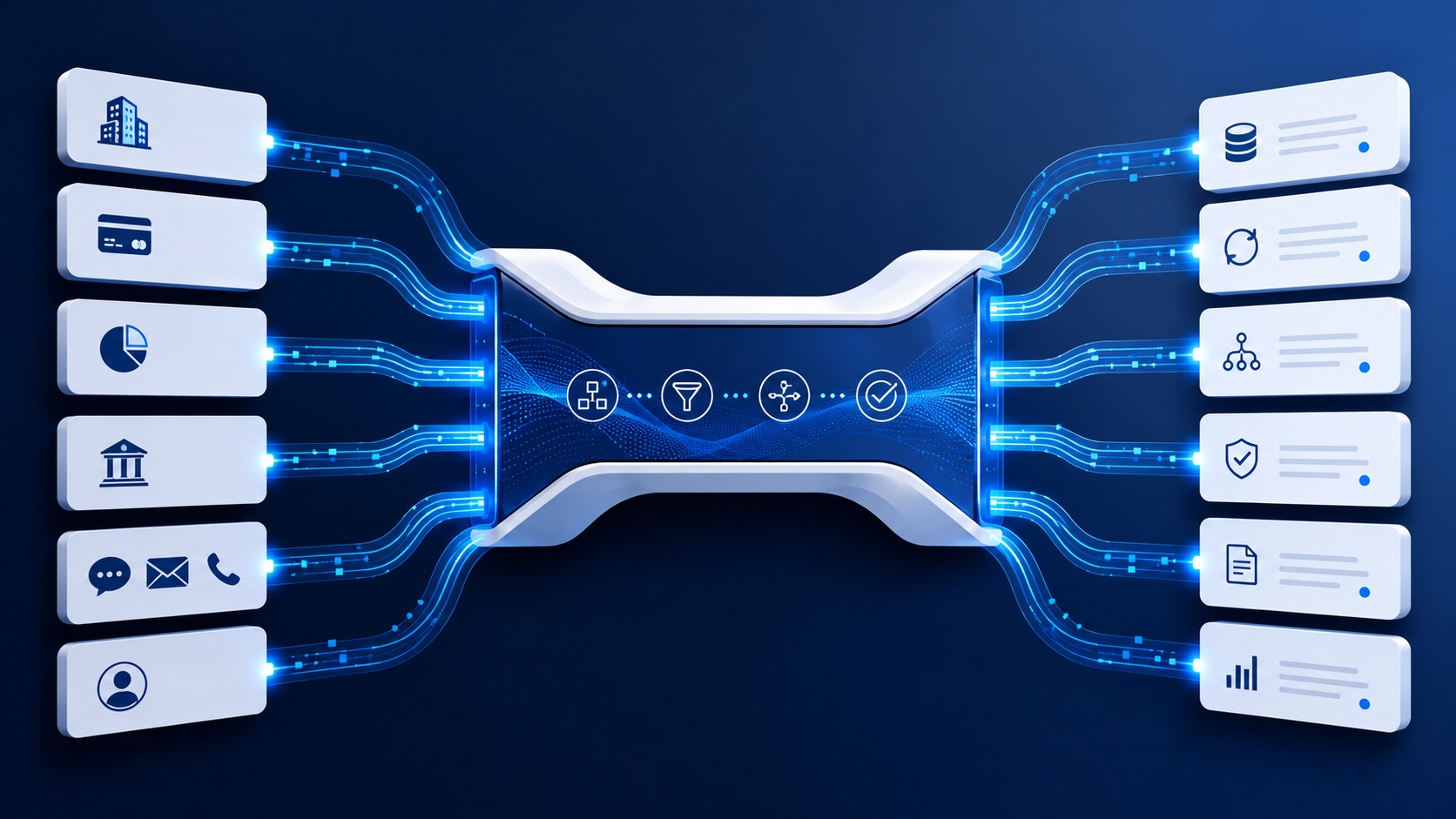
That is the role of a data orchestration platform. It coordinates data workflows so account events move through the right systems in the right order while preserving context as volume, clients, integrations, automation, and AI grow.
What Is a Data Orchestration Platform?
Data integration connects systems. Data orchestration coordinates the movement, transformation, validation, and use of information across those connections.
Consider a consumer payment. An orchestration flow can match the transaction, update the balance and payment plan, reevaluate the collector queue, stop unnecessary outreach, refresh client reporting, and prepare the record for reconciliation.
That is why agencies evaluating debt collection software integrations should look beyond whether two systems can exchange a file. The real question is whether the integration can participate in an operational workflow.
Data Integration vs. Data Orchestration
Point-to-point data integration answers, "Can system A send information to system B?" APIs and webhooks make that exchange faster and more flexible. Workflow automation determines actions such as assigning an account, sending a message, or routing an exception. Workflow orchestration coordinates those actions across multiple systems and dependencies.
In data engineering, data pipelines support ingestion, ETL, ELT, and data transformations across data sources. ETL transforms before loading; ELT and ELT workflows load first and transform later. Reverse ETL can move modeled information back into applications for data activation. The same principle applies in collections: usable data must reach the right workflow at the right time.
Why Collection Agencies Need Data Orchestration
Keep Creditor and Agency Systems Aligned
Every placement begins outside the agency. A creditor may send accounts through APIs, secure files, a billing platform, or another data platform. The agency then needs accurate balances, consumer information, documents, client rules, status changes, recalls, and later updates.
Good data quality starts at ingestion. Validation should catch missing fields, duplicated records, malformed values, and unexpected changes before they become collector work. At higher volume, data management and data governance also matter: teams need to know which system owns each field, who can change it, and how corrections move downstream.
Coordinate Payments and Account Status
Payment data is one of the clearest examples of orchestration. A card, ACH, portal, or AI-assisted payment should update more than a transaction table. It may need to change an account balance, payment plan, outreach eligibility, client remittance, dashboards, and audit logs.
Separate batch processing jobs can create stale states. Event-driven triggers reduce lag by initiating approved actions when an account event occurs. Teams should still define an authoritative record, task order, and retries for failed steps.
Connect Communication Activity
Calls, SMS, email, letters, voicemail, and consumer portal activity all produce operational data assets. Orchestration keeps those events tied to the same account history. If a consumer pays, disputes an account, updates contact information, or changes a communication preference, the next workflow should see that current state.
This is where data silos become especially costly. A communication provider can work perfectly on its own and still create a bad outcome if it is acting on stale information.
Support AI With Reliable Account Context
AI agents and machine learning models depend on current, permissioned information. An LLM should not operate from a separate snapshot while the collection platform continues changing underneath it. Our guide to why AI agents need real-time collections data explains why account context, workflow status, and write-back matter as much as the model itself.
The same principle applies to data security. Role-based access control should determine which users, services, and AI agents can view or change sensitive information, while audit logging makes those actions traceable.
What a Collection Data Orchestration Workflow Looks Like
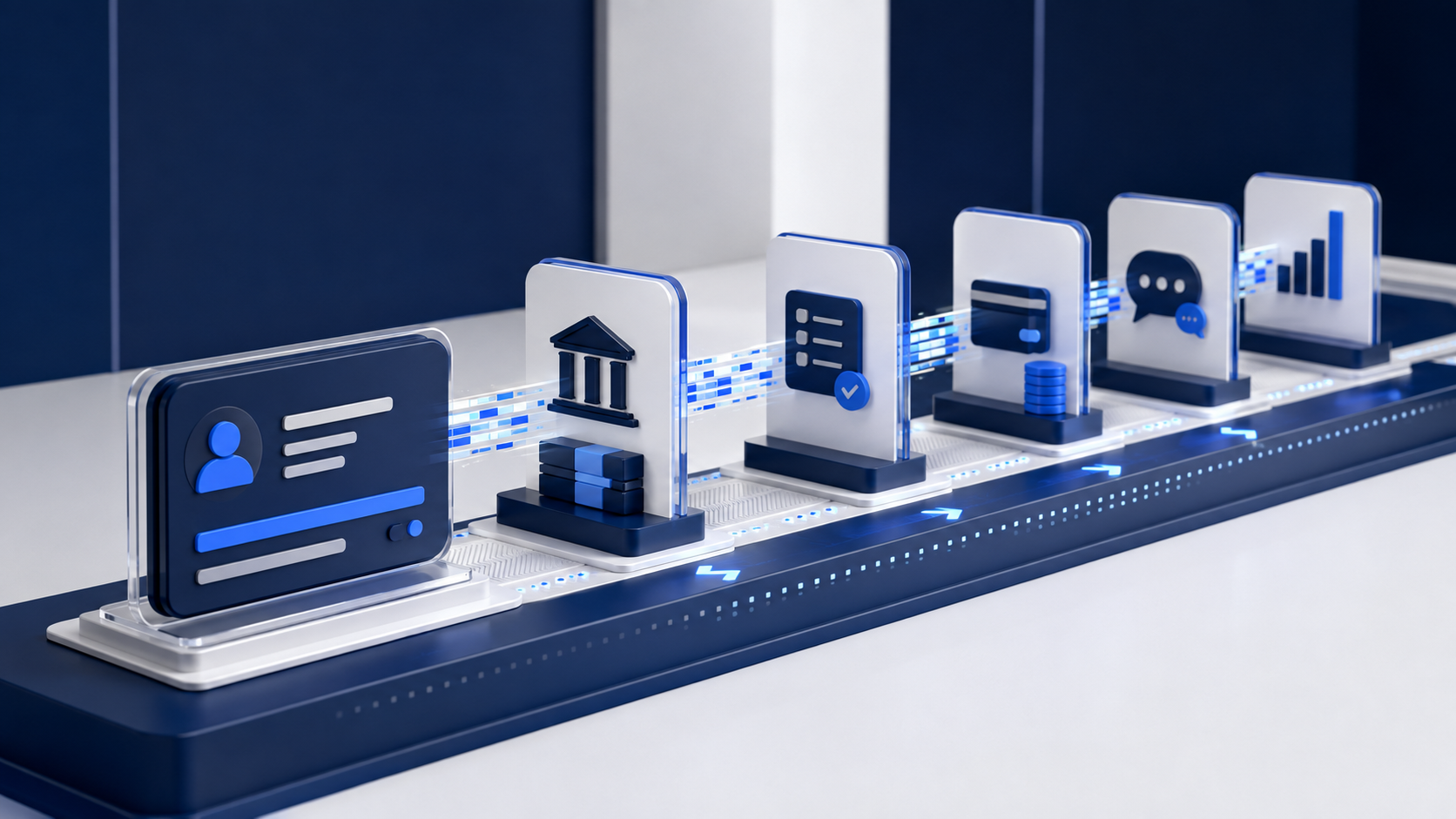
A creditor places an account, data ingestion validates fields and mappings, and data workflows assign the right client, portfolio, and outreach logic. When the consumer pays, responds, uploads documentation, or disputes the account, that event updates the collection record and triggers reporting and other downstream actions.
For enterprise agencies, the same pattern may span several data platforms and a modern data stack. Data warehouses or data lakes can support business intelligence, while Snowflake or Databricks may hold analytical data. SQL may be used to model or query those records. Pre-built connectors can accelerate integration, but only if they preserve the event sequence and error handling the agency needs.
How General Data Orchestration Tools Fit In
The wider data engineering market includes data orchestration tools such as Apache Airflow, Dagster, and Prefect. Apache Airflow models dependencies as DAGs, or directed acyclic graphs, so teams can control task order, scheduling, and retries. Dagster emphasizes data assets, lineage, observability, and testability. Prefect also focuses on workflow management and orchestration.
Transformation tools such as dbt are commonly used with SQL and version control to build reliable analytical models. DataOps and DevOps teams may deploy these systems on Kubernetes and monitor data pipelines through observability tooling.
These technologies can play an important role in a broader data stack, but they operate at a different layer than collection software. Agencies still need a modern operating system that understands placements, consumer status, payments, disputes, client requirements, communications, and compliance-aware actions under rules such as Regulation F. A platform like Aktos brings that collection-specific logic together in one environment, giving agencies the orchestration capabilities they need for day-to-day operations without requiring them to build and maintain collection workflows across separate technical tools.
What to Look for in Data Orchestration Platforms
For a collection agency, the most useful data orchestration platforms should support open APIs, flexible data integration, event-driven triggers, configurable logic, and strong failure handling. They should make data quality visible instead of hiding failures inside integrations.
Observability should show whether data pipelines and operational workflows are completed. Teams need visibility into failed ingestion, delayed events, dependencies, retries, and downstream impact. A unified control plane can help administrators see what is running without stripping domain control from operations.
Enterprise buyers should also evaluate data governance, role-based access control, data security, and audit logs. If a workflow spans creditor systems, the collection platform, data warehouses, and AI, the agency should be able to reconstruct where information came from and what happened to it.
For a deeper look at enterprise connectivity, our guide to debt collection API integration covers placements, payments, disputes, reporting, and governance across connected systems.
How Modern Collection Software Becomes the Orchestration Layer
Agencies do not necessarily need to build a separate orchestration project around legacy systems. Modern collection software can coordinate account data, payments, communications, workflows, reporting, and integrations while connecting to specialized data engineering infrastructure where needed.
Aktos is designed around that model: open APIs, configurable workflows, integrated communications and payments, real-time reporting, and AI working from a shared account context. The value is not simply that systems connect. It is that the connections can support one coordinated collection operation as clients, account volume, and automation expand.
Final Thoughts
Collection technology is moving from isolated applications toward coordinated systems. The strategic question is no longer only, "Can these systems connect?" It is, "Can they operate as one collection workflow?"
A strong data orchestration platform helps answer that question by connecting data pipelines, operational events, data quality controls, AI, and downstream actions. For enterprise collection agencies, that coordination is what turns a growing technology stack into infrastructure that can actually scale.
FAQs
Q: What is a data orchestration platform?
A: A data orchestration platform coordinates how data moves, changes, and triggers actions across systems. In a collection agency, that can include placements, payments, communications, client reporting, and AI workflows.
Q: What is the difference between data integration and data orchestration?
A: Data integration connects systems and transfers information. Data orchestration coordinates multiple integrations, dependencies, data transformations, and actions so the full workflow reaches the intended state.
Q: Why do collection agencies need data orchestration?
A: Agencies need orchestration to keep creditor systems, collection software, payment providers, communication channels, dashboards, and reporting aligned as account activity changes.
Q: Can data orchestration support AI automation?
A: Yes. Orchestration can provide AI agents and machine learning models with current account context, then write outcomes back into approved workflows instead of creating a separate AI data silo.
Q: Do agencies need Apache Airflow, Dagster, or Prefect?
A: Not necessarily. Those tools are useful in data engineering environments, but a collection agency should first determine whether its collection platform can coordinate the operational workflows that are unique to collections.