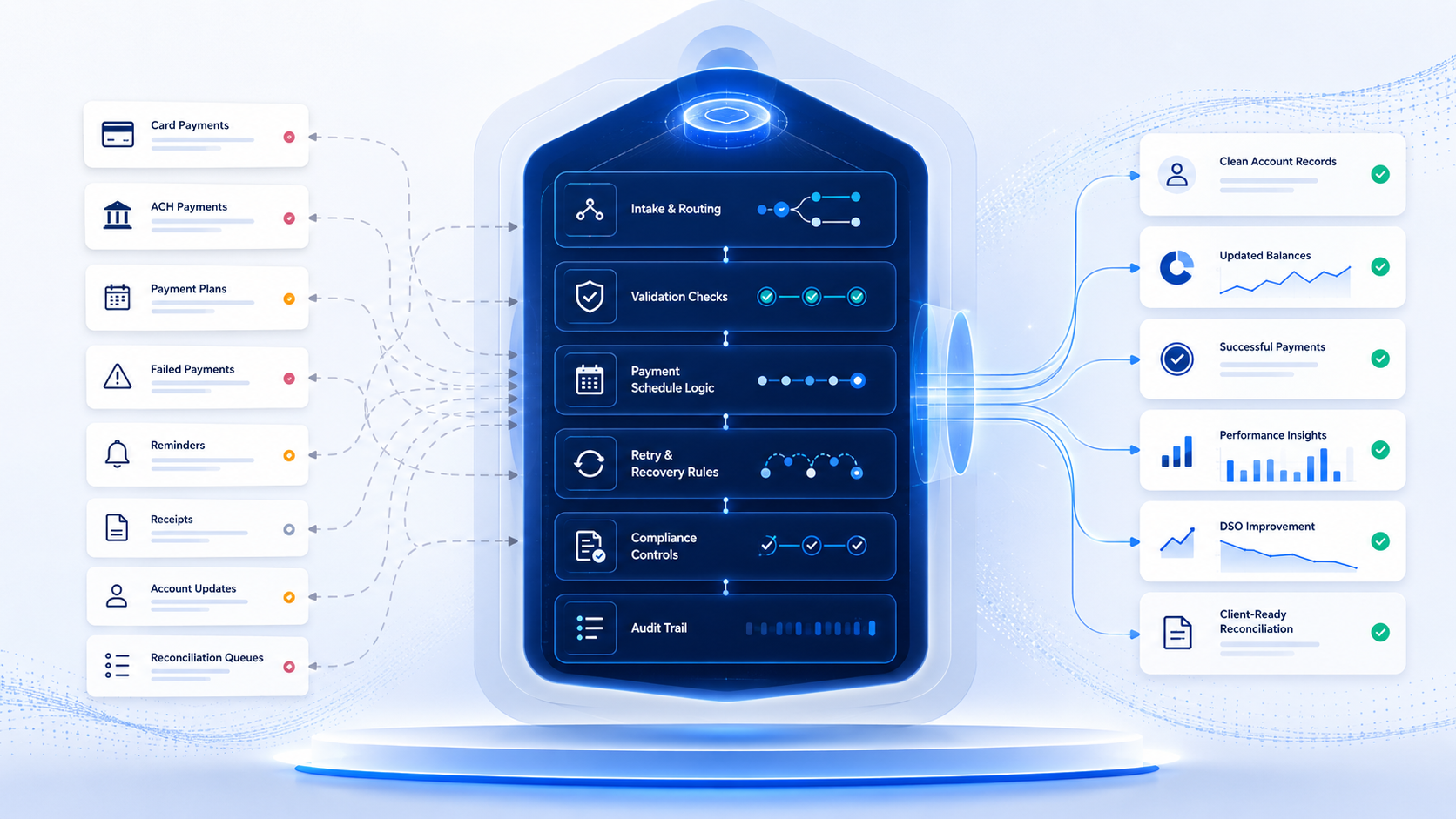

Payment Reconciliation for Collection Agencies
At enterprise scale, most payments should move through the collection operation without anyone touching them. The hard work begins when one record disagrees with another: a payment appears at the processor but not the ledger, a settlement is short because of bank fees, or a chargeback changes an account after it previously seemed to be resolved.
That is why payment reconciliation should be designed around exception management. Clean transactions should pass automatically while discrepancies route to the right owner with enough context to resolve them. Payment status affects balances, collector queues, payment plans, client remittance, financial reporting, communication suppression, and audit readiness. When those systems disagree, operational efficiency drops and revenue leakage becomes harder to spot.
Most Payments Reconcile Easily, Exceptions Create the Work
Straight-through payment reconciliation starts with matching transactions across the collection platform, payment gateways, bank activity, and client records. If the amount, account identifier, transaction status, and settlement data agree, automation should close the loop without creating another task for finance.
Exceptions deserve a different path. High volume magnifies small inconsistencies, so a one-off data issue can become hundreds of unresolved items if the workflow is not structured. That is where manual reconciliation becomes expensive: staff compare bank statements, payment processor reports, transaction records, and accounting records one line at a time while identifying discrepancies that software could have isolated first.
The better model is simple: automate transaction matching, surface the mismatches, and make every exception explainable.
What Collection Agencies Need to Reconcile
A complete reconciliation process should connect the consumer payment, payment processor event, bank settlement, collection-system ledger, client remittance, and agency fees. It should also handle cards, ACH, and digital wallets without losing transaction context.
Finance may send activity into accounting software, an ERP, QuickBooks, or another ledger environment. But collection payment reconciliation is not the same as bank reconciliation or accounts payable reconciliation. Those processes are part of the accounting process and focus on accounting books and financial statements; agencies must also preserve account status, client ownership, collector visibility, and the consumer-facing balance. Cash reconciliation therefore has to answer both financial and operational questions.
At Aktos, we cover the broader payment lifecycle in its guide to debt collection payment automation, including arrangements, failed-payment handling, posting, and reporting.
Exception #1: Unmatched Payments
An unmatched payment often starts with incomplete or inconsistent identifiers. The processor may have a transaction ID but no usable account number, the consumer may enter information incorrectly, or an imported file may not map cleanly to the agency record.
Instead of leaving those items in a generic finance inbox, route them into an exception queue with the payment amount, processor reference, available consumer data, age, and owner. Staff can then research the smallest set of unresolved items rather than repeat the entire reconciliation cycle.
This structure improves financial accuracy and reduces data entry errors because the resolution becomes a controlled workflow rather than an improvised correction.
Exception #2: Duplicate Transactions
Duplicate payments can come from repeated authorization attempts, duplicate posting, import retries, or overlapping integrations. The first job is to determine which event is authoritative.
The system should preserve both records, flag the duplicate relationship, and prevent staff from “fixing” the issue by simply deleting history. Good internal controls make the correction visible and protect financial records from unexplained changes. They can also support fraud detection by helping reviewers separate a true duplicate from suspicious activity that may require a different investigation.
Exception #3: Refunds and Reversals
Refunds and reversals should restore the account correctly without erasing the original payment story. If a successful payment is later reversed, the balance, payment-plan status, collector workflow, and client reporting may all need to change.
The original transaction should remain intact, followed by the reversal or refund as a new event. That creates an audit trail showing what happened instead of replacing the past with the latest state.
For agencies handling cards, the PCI Data Security Standard provides the baseline security requirements for environments that store, process, or transmit payment card data.
Exception #4: Chargebacks
Chargebacks require more context than a standard reversal. Operations may need the original payment, processor data, communication history, authorization details, supporting documentation, and resulting account impact in one place.
The workflow should define what happens next: whether the account returns to an active queue, an arrangement changes, a supervisor reviews it, or the client reporting updates.
For ACH activity, agencies should understand applicable return workflows and processor requirements. The current Nacha Operating Rules include ACH participant obligations and return reason information that can inform internal procedures.
Exception #5: Processor and Convenience Fees
Gross payment amount and net bank settlement are not always identical. Processor charges, convenience-fee treatment, or other bank fees can create apparent mismatches even when the underlying consumer payment is correct.
The answer is to preserve separate transaction components rather than force a single number to represent everything. Clear journal entries can distinguish principal collected, agency fee treatment, processor cost, and client remittance. That makes credit card reconciliation cleaner and prevents legitimate fee differences from looking like missing money.
Processor documentation on reporting and reconciliation shows how transactions can be matched to payouts during the reconciliation process.
Exception #6: Partial Settlements and Complex Arrangements
A partial settlement is not simply a smaller payment. The system needs to understand the agreed settlement terms, amount received, remaining balance if any, and whether the arrangement is complete, active, or broken.
Missed payments need similar treatment. A failed installment may require a reminder, collector task, revised schedule, or client-specific escalation. The payment event and the account workflow should remain connected so collectors are not operating from stale information.
Build an Exception Queue
A strong exception queue records the reason, owner, amount, age, priority, and resolution status for every unresolved item. It should also support filters by client, processor, payment type, or portfolio so managers can see whether one integration or workflow is creating disproportionate cleanup.
This is where an API can improve scale. Rather than waiting for periodic files, the agency can ingest processor events, settlement updates, and status changes as they occur, then route only mismatches for review. Our guide to debt collection API integration explains why real-time data exchange matters for enterprise workflows.
Use Audit Trails to Preserve the Full Payment Story
Every adjustment should preserve the original event, the change, the user or automated workflow responsible, the timestamp, and the explanation. That supports regulatory compliance, client questions, internal review, and audit readiness without forcing teams to reconstruct the history later.
A strong audit trail also helps teams distinguish potential fraud from ordinary reconciliation noise. When access, changes, approvals, and transaction history are visible, unusual patterns are easier to investigate, while proven audit trails for debt collection compliance can provide a broader framework for building that visibility.
Payment Reconciliation Metrics
The most useful metrics are the auto-match rate, exception rate, aging exceptions, unresolved dollar value, and average resolution time. Teams can also track exception reasons to identify recurring integration failures or training gaps.
These measures connect reconciliation to financial health, liquidity, cash flow management, client remittance, and the reliability of financial statements. The goal is a payment operation leadership can trust.
Final Thoughts: Reconciliation Should Focus Human Attention
Enterprise agencies do not need more people comparing every transaction. They need payment reconciliation that automatically clears the normal activity and concentrates human attention on exceptions.
When payment data, account records, workflows, reporting, and integrations stay connected, we spend less time searching for differences and more time resolving the cases that genuinely require judgment. With Aktos, we bring payments, account history, automation, reporting, and exception workflows into the same operating environment.
FAQs
Q: What is payment reconciliation?
A: It confirms that payment activity agrees across the processor, bank settlement, collection ledger, client remittance, accounting records, consumer balance, and related workflows.
Q: Why do payments fail to reconcile?
A: Common causes include missing identifiers, timing differences, refunds, chargebacks, duplicate payments, fees, data entry errors, partial settlements, and integration failures.
Q: How should collection agencies handle chargebacks?
A: Preserve the original transaction, capture the processor event and supporting records, update the account impact, and route the case through the agency’s approved review process. Agencies should follow processor requirements, client rules, and qualified legal or compliance guidance where applicable.