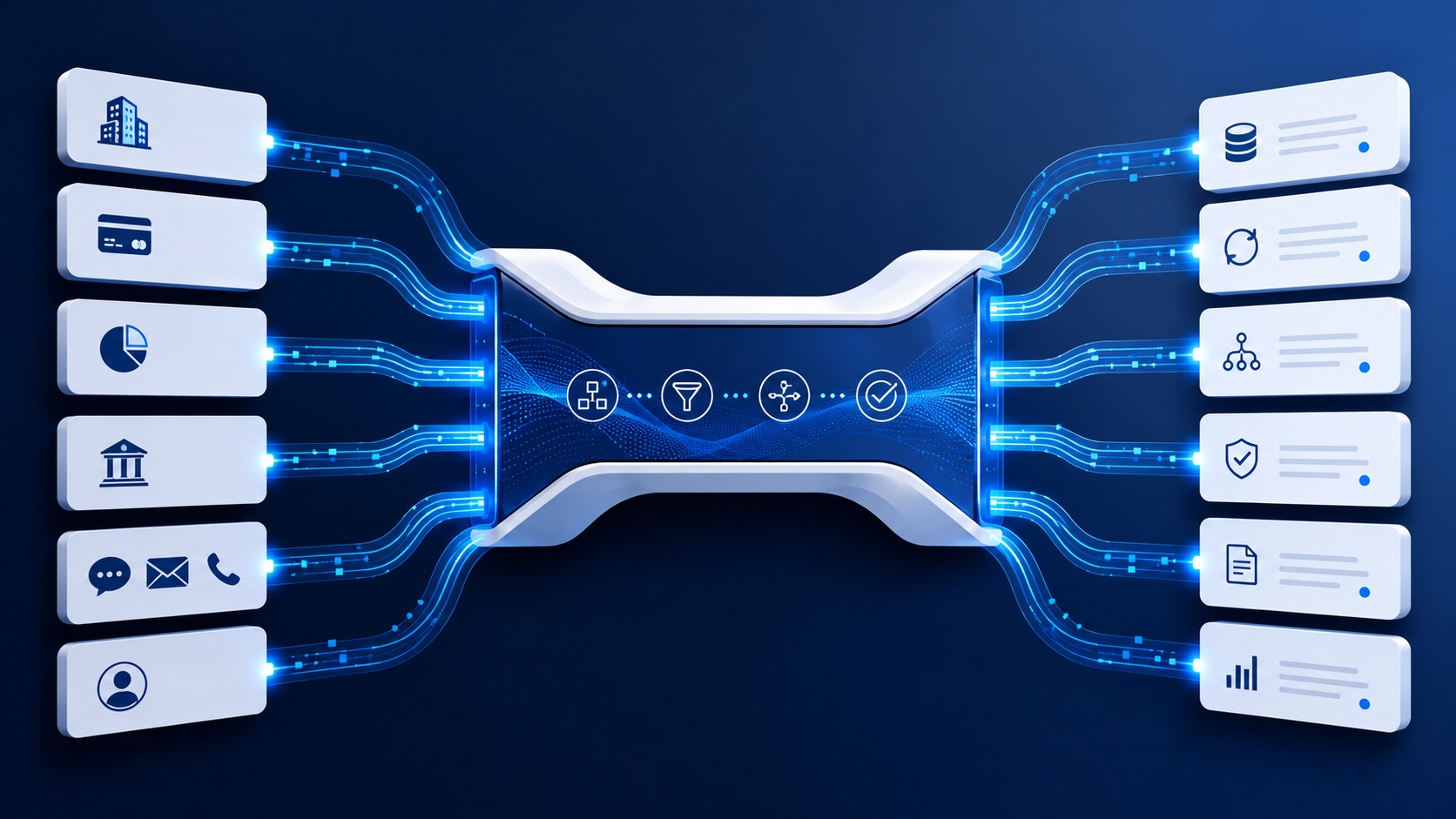
One creditor sends customer_id. Another sends debtor_number. A third uses account_ref. All three may represent the same concept, but collection software cannot safely assume that on its own.
The same problem appears across balances, dates, status codes, dispute flags, payment fields, and client identifiers. Every creditor may send data in a different structure. Without a repeatable mapping layer, intake turns into one-off scripts, manual data mapping, and institutional knowledge..
Data mapping software solves that problem by defining how source data should translate into the agency's internal model before it reaches collectors, workflows, payments, reporting, or artificial intelligence.
How Your Collection Software Maps Data
Data mapping creates explicit relationships between source and target schemas. A source field may be renamed, reformatted, combined, split, or translated before it lands in the target system.
Schema mapping can rename fields, change supported data types, and control which properties continue into downstream systems..
For collection agencies, the target is the operating workflow. A mapped field can determine client ownership, collector balance, dispute routing, payment reporting, or exception handling.
That makes data quality, data governance, and data mapping inseparable. The mapping can be technically valid and still be operationally wrong if it puts a correct value into the wrong business field.
Start With the Target Data Model
The safest mapping process begins with the agency's standard data models, not with whatever file a creditor happens to send.
Define target fields for consumer identity, account number, creditor details, balances, placement dates, contact information, communication preferences, disputes, payment arrangements, documents, reporting dimensions, and special-handling indicators. Then map each client's source values into that model.
This prevents client-specific quirks from spreading downstream. Collectors should see the correct value in the same place every time, regardless of the source field name.
The Data Mapping Process for Collection Agencies
1. Profile the Source and Detect the Schema
Before building mapping rules, confirm what the file or API actually contains. Schema detection should identify field names, types, required values, and unexpected changes from previous placements.
If one source suddenly changes a date field from text to numeric or adds a new status value, that change should become an exception before thousands of accounts import incorrectly.
2. Perform Field Mapping and Data Transformation
Some field mapping is direct: consumer_first_name becomes first_name. Other mappings require data transformation and transformation logic.
A client might send Y/N while the target expects a Boolean. A date may need reformatting. A client status code may need to translate into the agency's standard account status. These transformation rules should be documented, versioned, and testable.
In traditional data engineering, this work may occur through ETL (extract, transform, load) or ELT, where raw data lands before transformation. Collection agencies may also use data pipelines connecting client files, APIs, payment providers, reporting environments, data warehouses, and data lakes..
3. Support APIs as Well as Files
APIs do not eliminate mapping; they make it continuous. A REST API may exchange placements, balance updates, disputes, documents, and payment events throughout the account lifecycle.
JSON is a common structured format for API traffic and provides a lightweight way for systems to exchange data. XML still appears in many enterprise integrations, especially in environments connecting older systems with newer platforms.
A modern API integration should define ownership, validation, transformation rules, and error handling for every field. Strong debt collection API integration practices keep real-time data synchronized with the correct account state across connected systems..
4. Preserve Data Lineage and Version Control
Mapping should never erase provenance. Data lineage lets the agency trace a target value back to the original client value and the transformation that produced it.
Version control matters for the same reason. When an administrator changes mapping rules, the agency should know who changed them, when the change became active, and which placements used the new logic. Metadata management can make that history easier to search and govern.
5. Validate the Mapped Output
A source file can pass basic checks and still map incorrectly, so data validation should happen after mapping as well as before it. Test records should confirm balances, dispute routing, reporting, and downstream values; aggregation totals should reconcile to the source.
Where General Data Mapping Tools Fit
The broader market includes many data mapping tools and data integration tools. Platforms such as Informatica, Boomi, MuleSoft, Fivetran, Pentaho, and Integrate.io can support enterprise integration, pipeline movement, transformation, ETL/ELT workflows, and iPaaS architecture. Many also use pre-built connectors to move data between applications, databases, APIs, and analytics environments.
Business intelligence teams may send standardized data into Tableau for reporting, while creditors may originate account information in a CRM such as Salesforce. These platforms can play an important role in the technology stack around a collection agency, especially for moving, transforming, and analyzing data across systems.
They do not, however, replace a collection operating platform like Aktos. General integration and mapping tools are not designed to manage collection-specific workflows such as creditor placements, consumer account status, disputes, payment arrangements, communication history, collector queues, client reporting, or compliance-aware account actions.
For agencies, the goal is not to choose between enterprise data infrastructure and collection software. A data mapping solution can help manage client-specific complexity at the integration layer, while Aktos provides the consistent account model and operational workflows that collectors, managers, and clients rely on every day.
Automated Data Mapping Still Needs Governance
Automated data mapping, machine learning, and artificial intelligence can suggest field matches or identify recurring patterns, but the agency still needs rules for approval and exceptions. A system should not guess that status_date means placement date simply because the data types look similar.
Mapping rules also need to reflect the privacy, security, and client requirements that apply to each portfolio. Frameworks such as HIPAA, CCPA, and SOC 2 do not determine how fields should map, but they can shape access controls, auditability, and the handling of sensitive data..
Good collection software integrations do more than move data successfully between systems; they ensure that connected data triggers the correct downstream collection workflow..
What Changes During Data Migration
A data migration exposes mapping problems quickly because historical records often contain years of client-specific codes, legacy statuses, custom fields, and exceptions.
The migration plan should separate mapping from cleansing, test representative records, reconcile totals, and preserve source history. A disciplined collection software data migration process validates those mappings and confirms accuracy before the new system goes live..
Where Aktos Fits
Aktos is designed around open APIs, configurable workflows, and connected account data. Agencies can use client-specific mapping and validation logic to standardize incoming information before it drives collector work, payments, communications, reporting, and AI workflows..
The goal is not to force every creditor to send the same file. It is to absorb different client formats while maintaining a consistent internal operating model.
Final Thoughts: Map Complexity at the Edge
Collection agencies cannot control how every creditor names fields or structures data. They can control what happens when that information enters the collection environment.
Strong data mapping software defines a stable target model, applies repeatable mapping rules, preserves data lineage, validates mapped outputs, and routes exceptions before they affect production. That becomes more valuable as client count, API volume, and integration complexity grow.
FAQs
Q: What is data mapping software used for in a collection agency?
A: It translates creditor-specific fields and values into the agency's standard data model so accounts enter consistent workflows for collections, payments, disputes, reporting, and integrations.
Q: What is the difference between data mapping and data integration?
A: Data integration connects systems and moves information between them. Mapping defines how individual fields, values, and schemas translate from one system into another.
Q: Do APIs remove the need for data mapping?
A: No. APIs change the transport method, not the need for schema mapping. Every API still needs clear definitions for source fields, target fields, validation, ownership, and exception handling.
Q: When should an agency use general-purpose data mapping solutions?
A: General platforms can be useful for enterprise pipelines, data warehouses, and cross-system integration. The collection platform still needs the final mapping logic that determines how account data affects operational workflows.