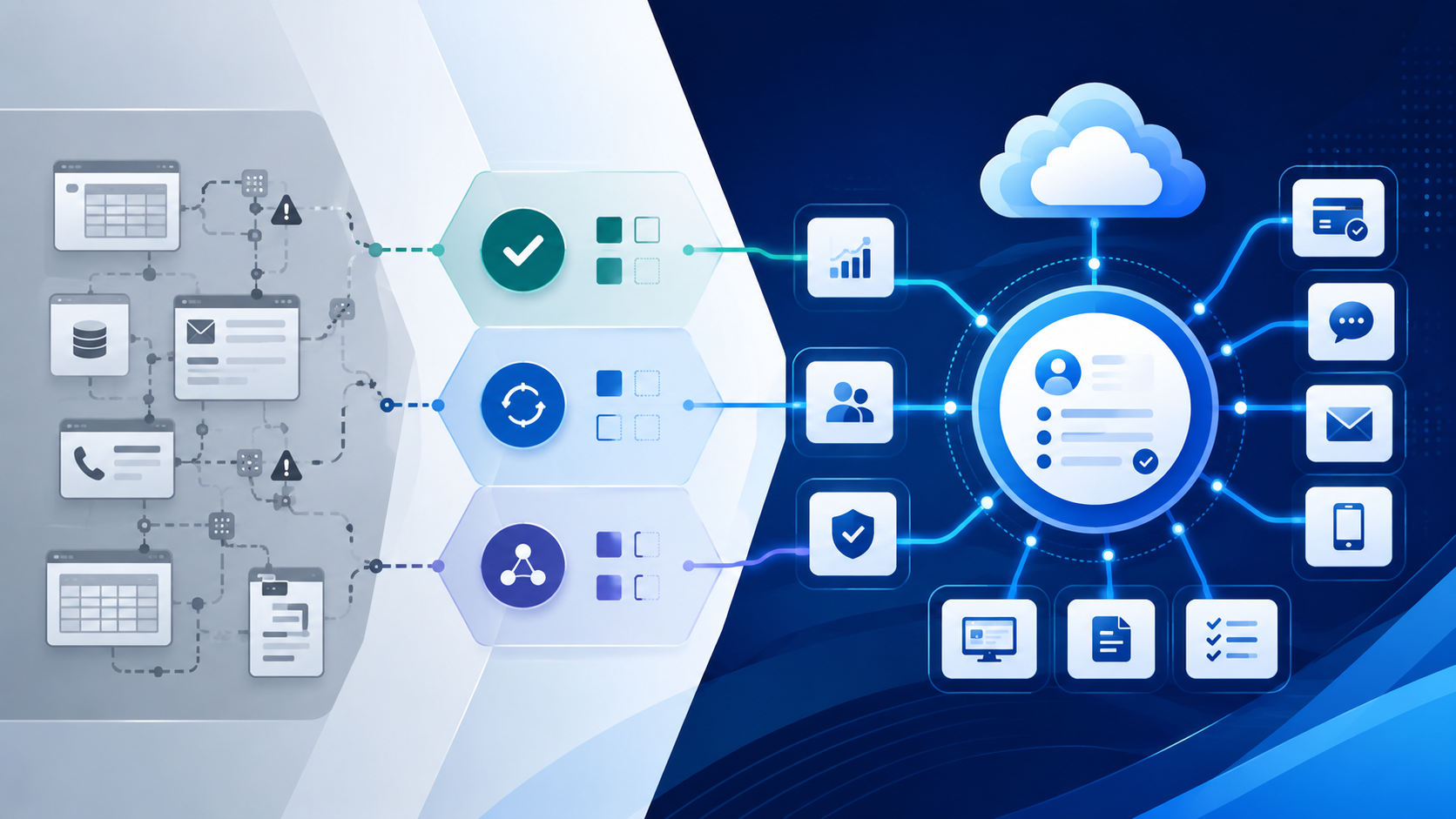

When a collection agency replaces its old software, the visible challenge is moving millions of account records. The harder challenge is preserving the decisions those records represent: why an account is held, who approved a settlement, which message was already sent, and what is scheduled next. A recovery management system migration succeeds only when the new platform can continue the agency’s work without losing that context.
Inventory Legacy Recovery Workflows Before Migration
Interview debt recovery collectors, supervisors, finance, compliance, legal, and client services. Document how placements enter the system, how queues are assigned, how balances change, how exceptions are reviewed, and which external vendors receive files. Capture hidden dependencies such as custom status codes, scheduled jobs, letter triggers, and historical reports.
Legacy recovery workflows often contain rules that no one remembers approving. Some may be essential requirements from clients or loan servicers; others may be workarounds that can be retired. Separate policy from historical implementation so the new system reproduces the desired operating outcome rather than recreating unnecessary friction.
The migration should preserve the recovery strategy behind each account, not just its label. Debt collection agencies need to know why debtors were placed on hold, who approved exceptions, and which actions remain appropriate. Separate required controls from historical workarounds so new debt collection software reproduces the intended outcome without carrying every old limitation forward.
Begin collection migration planning with the work collectors actually perform, distinguishing required controls from historical workarounds before deciding which account states and dependencies the replacement system must preserve.
Map Account States, History, and Vendor Dependencies
For recovery management systems, build field-level mappings for account identifiers, client and portfolio IDs, original and current balances, payments, disputes, consumer restrictions, arrangements, contact history, and documents. Treat mapping as a business decision, not merely an extraction exercise. A “closed” code can mean paid, recalled, settled, or otherwise inactive; those meanings must not collapse into one generic status.
Inventory dialers, payment processors, letter vendors, skip tracing services, creditor data feeds, and client reporting. Specify how authentication, data exchange, retries, and exception alerts will work after cutover. Preserve the source and change history when converting account records. A successful row count does not demonstrate a successful migration if the wrong actions become eligible.
Treat case management history as part of the account, not optional background. Loan servicers and BPOs may have different responsibilities in the handoff; document those boundaries before transferring data. Data protection controls should preserve access restrictions as records move. A correct row count cannot establish regulatory compliance if account states permit the wrong next action.
Use API-first software migration to identify every creditor feed and vendor connection that must keep working, including the ownership of failed updates, retries, and account-state reconciliation after conversion.
Validate Recovery-System Cutover With Real Accounts
Evaluate recovery management solutions with a realistic pilot including active arrangements, disputed accounts, recalled placements, accounts with partial payments, and clients with unusual reporting needs. Reconcile balances and key counts between systems, then run workflow simulations. Confirm users have the right roles and can retrieve historical documents. Train against actual agency cases rather than generic navigation slides.
Create a cutover plan with clear owners for conversion, finance reconciliation, integration testing, compliance review, and go/no-go approval. Define rollback criteria and vendor dependencies in advance. During the first days after launch, monitor failed files, incorrect queue assignments, blocked payments, unmatched transactions, and consumer-contact exceptions closely. A controlled debt recovery transition prioritizes continuity and stable recovery rates over a ceremonial launch date. Keep the prior account state available during validation. If the new system proposes an unexpected action, compare the original restriction and workflow history before proceeding. Staff should know how to pause the affected process and reach the responsible owner without disabling unrelated client work during review.
For leadership, the evaluation question is not only whether the process works when every input is clean. It is whether an administrator can identify a bad source record, a delayed vendor event, a mismatched rule, or a missing approval before it becomes a costly consumer or client issue. Give exception rates and resolution times the same attention as completed work. Otherwise a fast process can conceal a growing review backlog.
Run a collection data migration checklist against real account scenarios, checking balances, restrictions, documents, and integration outcomes before treating a successful import count as evidence of operational readiness.
Assign Migration Owners and Test Exception Paths
Assign one accounts receivable management owner across collections, finance, compliance, technology, and client services. Define required account data, authorized actions, and human review points. Revenue recovery continuity depends on that ownership: each team should know who resolves a missing restriction, broken payment connection, or conflicting client instruction during transition.
Choose five legacy account states that cannot safely be flattened during migration: an active dispute, approved settlement, recalled placement, pending payment, and existing communication restriction. For each, map the old status to the new action rules and preserve the underlying history. Run the converted accounts through dialer, payment, and reporting tests before cutover. A mismatch should block the affected workflow rather than become a production issue collectors discover later.
Confirm Historical Controls Survive the System Change
Migration deployment planning should specify approved release sequence, accountable teams, and launch-blocking checks. Have counsel review relevant transferred restrictions and technology teams confirm historical record access. Require evidence that notes, payment arrangements, and client exceptions remain usable before approving the recovery-system transition.
Ask recovery management solutions providers to follow a real account through an exception. Can a consumer make a payment, and can staff explain the resulting balance and history? Identify who approves migration rules and investigates discrepancies.
During an Aktos migration demo, check whether account restrictions, payment arrangements, client rules, and vendor connections can carry forward into the new system. Review how configurable workflows and APIs would support each transition.
Final Thoughts: Migrate Recovery Operations, Not Just Data
A recovery management system replacement isn't successful merely because the new database contains the right number of accounts. What matters is whether an active dispute stays on hold, an approved payment plan survives cutover, and a recalled account remains ineligible for outreach. Map those states before migration, reconcile balances and transactions, and test the connected vendors that will continue operating on day one. If a critical exception has no clear owner or rollback path, the cutover isn't ready.
Use an Aktos demo to review a representative legacy account and the decisions that must carry into the new environment.
FAQs About Recovery Management System Migration
Q: What data should migrate into a recovery management system?
A: Migrate verified account data or keep it accessible, balances, transaction history, restrictions, dispute and communication records, relevant documents, client rules, and audit evidence.
Q: How can teams verify a successful cutover?
A: Reconcile account and dollar totals, test representative edge cases, validate permissions and integrations, review outbound eligibility, and monitor early production exceptions.